Regulatory Impact Assessment at IBBI: International Best Practices and the Way Forward

Contents
- IBBI’s existing foundation
- International practices worth adapting
- 1. Purpose, scope and legal foundation
- 2. Proportionate screening and escalation
- 3. Problem definition, baseline and regulatory objectives
- 4. Alternatives and the explanation for choosing one
- 5. Twelve insolvency-specific impact dimensions
- 6. Evidence standards and an insolvency data plan
- 7. Consultation, inclusion and public reasons
- 8. Preparation, independent challenge and decision accountability
- 9. Decision record and urgent measures
- 10. Evaluation after implementation
- 11. A standard assessment statement
- 12. Testing the framework against a reporting reform
- 13. Phased adoption and monitoring of the framework itself
- 14. Recommendations for institutional adoption
- Conclusion
A regulation can be brief and still have substantial consequences for an insolvency process. Consider a hypothetical requirement for an additional disclosure before inviting resolution plans. It could improve the information available to bidders and help creditors judge competing proposals. It could also require another round of verification, increase professional work and postpone invitations. The relevant question is whether that particular requirement produces sufficient improvement, for the people affected, to justify its burdens—and whether a different design could achieve the objective more effectively.
Regulatory Impact Assessment, or RIA, provides a structured way of answering such questions. It connects a diagnosed problem with alternative responses, expected effects, implementation arrangements and subsequent evaluation. The OECD's best-practice principles place this exercise within a broader commitment to necessary, effective, proportionate and transparent regulation. They also support different depths of analysis and transparent screening, subject to oversight. [1]
For the Insolvency and Bankruptcy Board of India, the value of this approach lies in making the reasoning behind regulatory choices sufficiently explicit to be tested. A proposal to reduce procedural delay should identify the step responsible for the delay and explain how the proposed change will alter it. A proposal intended to improve participation should identify the people currently excluded, the obstacle they face and the evidence that the proposed remedy will help. These explanations create a basis for meaningful consultation and later review.
The distinction between assessment and cost-cutting matters particularly in insolvency. Removing a requirement may save time while weakening verification or reducing access to information. Adding a safeguard may impose an immediate expense while preventing a larger loss. Both possibilities deserve examination. Compliance expenditure belongs in the assessment, alongside effects on value preservation, participation, competition, fairness and the practical conduct of proceedings. A recommendation to retain an effective safeguard can be as consistent with rigorous assessment as a recommendation to simplify a redundant form.
The distribution of effects requires equal attention. An improvement in one creditor group's receipts may reflect a redistribution of an unchanged pool. A faster process may help participants differently depending on when they receive payment and what information they possess. The assessment should therefore distinguish additional value from changes in who receives it, while explaining the importance of each. Statutory entitlements and procedural protections should be treated as constraints on the available choices; an attractive financial estimate cannot authorise their removal.
IBBI’s existing foundation
IBBI’s 2018 Mechanism for Issuing Regulations established a substantial foundation for assessment. Regulations 4–5 require a published proposal identifying its legal basis, problem, economic analysis, relevant international practices and implementation arrangements. The consultation period is at least 21 days, with comments and a general response published on IBBI’s website no later than notification; substantially different proposals require renewed consultation. Economic analysis must consider direct and indirect costs and benefits for society, the economy, stakeholders and the Board, and the Code’s objectives. Regulation 6 applies consultation and analysis to amendments. Regulation 7 requires review every three years, or earlier when warranted. Organisational matters are excluded, and regulation 8 provides a Governing Board-approved urgent route that can dispense with regulations 4–5. These are existing requirements, not elements of the proposed framework below. [2]
Published practice also matters. Board Note 58/2020, on improving corporate insolvency resolution timelines and information, included an express impact assessment comparing existing arrangements with individual notification of claimants and notification through information utilities. Another paper concerning online publication of stakeholder claims examined the proposal’s impact and costs. Both papers identified expected costs as well as benefits. These documents establish that options analysis and RIA terminology already feature in IBBI’s work. They do not establish that every later proposal has been assessed with the same depth, nor would a weakness in one paper prove a general absence of assessment. [3] [4]
In its July–September 2025 newsletter, IBBI described its annual and three-year review activity and announced wider use of the public-consultation process for guidelines, policies, specifications and standards. This is evidence of a stated broader approach; it does not, by itself, establish that the 2018 Regulations were amended or that every later instrument followed an identical process. [5]
A useful reform agenda therefore starts by mapping what exists: the assessments prepared, where they are published, how consultation changes proposals, the support available to policy teams, and how subsequent reviews use evidence. It should recognise good practice and identify specific weaknesses through a disclosed sample. Absence from a public page is not conclusive evidence that no internal analysis occurred. Equally, an internal assessment that cannot be examined by affected stakeholders offers less opportunity for informed challenge.
The next question is institutional: how can IBBI make the quality of assessment consistent enough to influence decisions across proposals and over time? A common method, reliable evidence, proportionate scrutiny and a connected public record could strengthen that process. Their adoption should be judged by whether they improve choices, not by whether they produce more documents.
International practices worth adapting
International practice offers several useful disciplines for organising this work. The OECD's October 2025 methodology is especially relevant because it addresses national regulatory authorities. It sets out a sequence covering problem definition, the counterfactual and alternatives, appraisal, delivery, and the decision proposal. Its conception of proportionality preserves these stages while adjusting the effort devoted to them. Qualitative assessment can be appropriate; a full monetary cost-benefit calculation is not invariably necessary. The model also provides for scrutiny of the depth chosen and for quality assurance. It operates within an authority's decision-making remit and supplements existing requirements. [6]
For IBBI, that approach would permit a concise assessment of a limited procedural amendment and more extensive work on a proposal affecting access, incentives or substantial costs. The shorter document should still explain the problem, alternative, expected effects and means of review. A claim that an amendment is minor should itself be open to examination. A small administrative change could have significant consequences for a group with limited resources, particularly if compliance requires specialised assistance.
Proportionality should also guide evidence collection. Asking every participant for a large new return may cost more than the information warrants. Existing administrative records, carefully selected samples and targeted consultation can sometimes answer the decision's central questions. Where information remains weak, the assessment should identify the uncertainty, explain its implications and consider whether the design can be revised or tested. Apparent precision obtained from unsupported assumptions would provide little reassurance.
The United Kingdom's Financial Conduct Authority illustrates how analytical challenge can become an identifiable institutional responsibility. Its published cost-benefit policy provides for an independent panel, consultation subject to exemptions, and disclosure of panel comments and responsive changes. The policy's materiality exemption concerns panel referral where annualised net direct business costs fall within minus £10 million to plus £10 million; it does not create a general exemption from all cost-benefit assessment. The FCA also distinguishes monetised results from wider judgement and does not require mathematical proof that benefits exceed costs. [7]
The useful lesson for IBBI is the separation of preparation from challenge. Those developing a proposal should have to explain their baseline, alternatives and assumptions to someone able to question them. An appropriate arrangement could combine internal economic and legal scrutiny with external expertise for significant or contested proposals. Publishing the material objections and the response would allow readers to understand whether scrutiny changed the analysis. Such a reviewer would advise on analytical quality; responsibility for the regulatory decision would remain with the authorised institution.
Evaluation supplies the connection between a forecast and experience. The FCA distinguishes impact evaluations, which seek to establish what an intervention changed relative to a counterfactual, from evidence assessments and post-implementation reviews. These answer different questions about emerging outcomes and implementation. Its approach recognises the need to account for other developments affecting the observed results. [8]
For insolvency regulation, this distinction prevents a favourable aggregate trend from becoming an unsupported claim of regulatory success. Changes in case composition, economic conditions or adjudicatory capacity could influence observed duration and recoveries. A review should ask whether the intended behavioural change occurred, whether the expected outcomes followed and how confidently they can be attributed to the measure. Planning that review when the rule is designed would help identify which baseline information must be preserved.
Australia provides a complementary example of analytical ownership. Its framework commencing on 1 July 2026 requires a senior official, at Deputy Secretary level or equivalent or above, to endorse a Statement of Sufficiency addressing the seven impact-analysis questions and a credible estimate of regulatory burden. The practical guide provides for publication of the signatory's name with the final assessment. [9] For IBBI, identifiable responsibility for analytical completeness could support an independent challenge process; certification by the originating institution would not itself constitute independent review.
These mechanisms need adaptation to India's insolvency arrangements. Neither a foreign regulator's financial threshold nor a government department's reporting structure establishes the right design for IBBI. The practical task is to organise evidence, scrutiny and review around the choices IBBI can lawfully make, preserve the rights established by the governing framework, and explain where the effectiveness of a proposal depends on other institutions. An insolvency-specific assessment framework can then turn those disciplines into a usable record of why a measure was chosen, what it was expected to achieve and what experience requires to be changed.
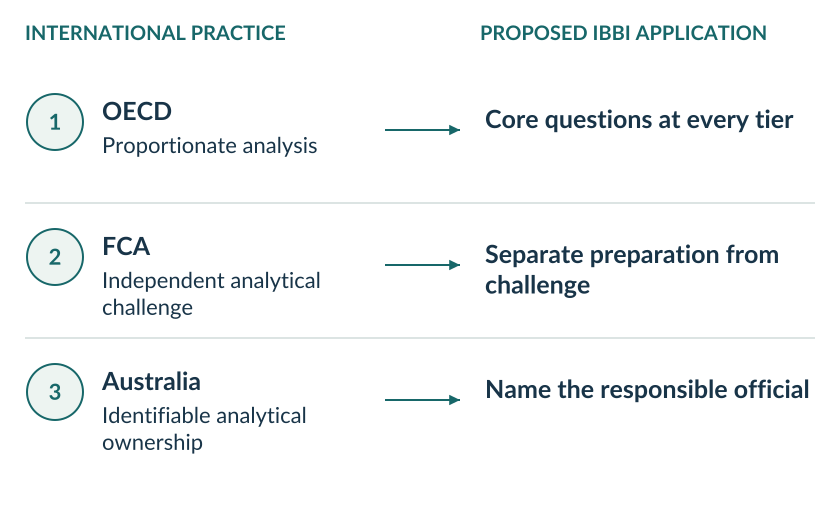
OECD proportionality suggests scaling analytical depth while retaining core questions. FCA scrutiny suggests challenge independent of preparation. Australian ownership suggests named responsibility for analytical completeness. These are proposed adaptations: foreign thresholds are not automatically suitable for IBBI, and author certification is not independent review. Sources: [6] [7] [9]
1. Purpose, scope and legal foundation
A proportionate insolvency-specific methodology should connect regulatory objectives, alternative interventions, stakeholder effects, implementation and subsequent evaluation. The proposed design below builds on IBBI’s existing arrangements. Its assessment dimensions, institutional mechanisms and indicative adoption periods are recommendations for consideration, not a description of additional duties already in force. A committee may adapt them to its mandate after examining the current legal route for each measure. The existing consultation and review requirements remain the legal starting point. [2]
The assessment concerns the design and review of regulatory measures. It is not an additional approval requirement for every insolvency case, commercial decision or resolution plan. Its purpose is to improve regulatory decisions while preserving the authority of the competent statutory decision-maker.
Building on that broader consultation approach, the proposed assessment methodology should screen new regulations, amendments, substantial revisions of forms and reporting systems, and other instruments with material regulatory effects. For circulars and guidance, the legal team should first establish the instrument's lawful scope: assessment cannot legitimise an obligation that requires a regulation or statutory amendment. Measures excluded from the present regulation-making framework need a separately justified administrative or legal route if the proposed methodology is to cover them.
Record whether the problem is within IBBI's powers, requires coordination with another institution, or requires legislative action. Recommendations concerning tribunal resources, judicial case management, substantive creditor priorities or the Code itself must be addressed to the competent authority. A favourable economic assessment cannot cure absence of legal power or justify an unlawful restriction of rights.
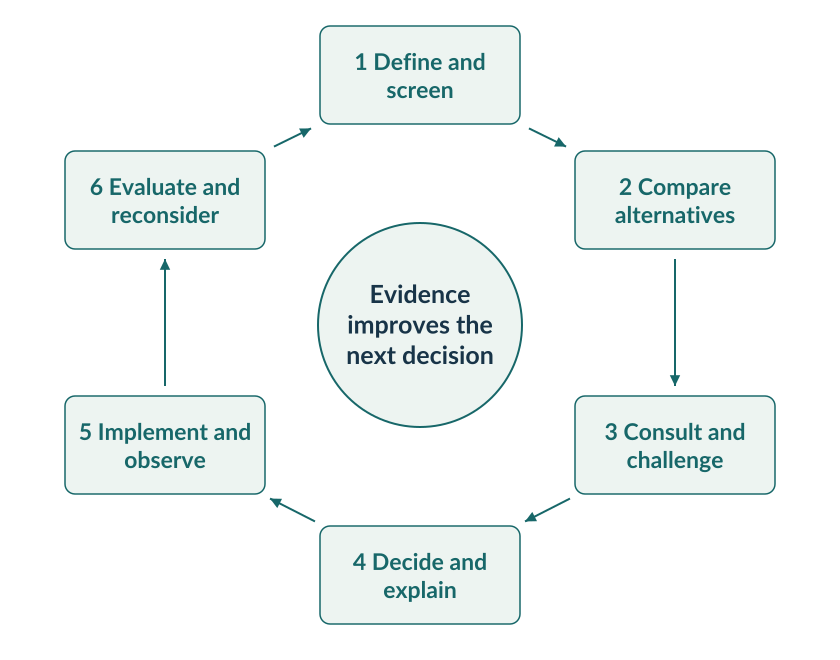
Define the problem, compare lawful alternatives, consult and challenge, decide and explain, implement and observe, then evaluate. Feed findings back into the next problem definition. The proposed cycle links assessment to learning rather than treating it as a one-off form.
2. Proportionate screening and escalation
Every covered proposal should begin with a published screening note determining the appropriate analytical depth, with a recorded reason and review by someone other than its author. Every resulting assessment should receive proportionate review independent of its author; enhanced assessments require fuller methodological challenge and may warrant external expertise.
Use three proposed levels:
- Concise assessment: narrow changes with limited effects, supported by evidence. Retain the problem, baseline, alternatives, affected groups, likely effects, implementation and review questions.
- Standard assessment: substantive changes affecting process, cost, information, participation or professional conduct. Require a structured options appraisal and stakeholder impact analysis.
- Enhanced assessment: changes with substantial or uncertain effects, significant distributional consequences, high transition costs, novel mechanisms, irreversibility or important institutional dependencies. Require independent methodological challenge and a more detailed evaluation plan.
Do not use monetary compliance cost as the sole screening criterion. A low-cost procedural change may affect access, participation or recoveries materially. Consider the number and diversity of affected cases, size and vulnerability of stakeholder groups, cumulative burden, effects on smaller estates and professional practices, competition, rights, data risks and implementation capacity. Assess related proposals together where splitting them would conceal their combined effects.
Calibrate any numerical thresholds from observed Indian data and pilot experience; consult on them and review them periodically. Do not transplant a foreign monetary threshold or invent a precise Indian cut-off without an evidentiary basis. Analytical tiering should not displace applicable consultation, publication or other legal requirements.
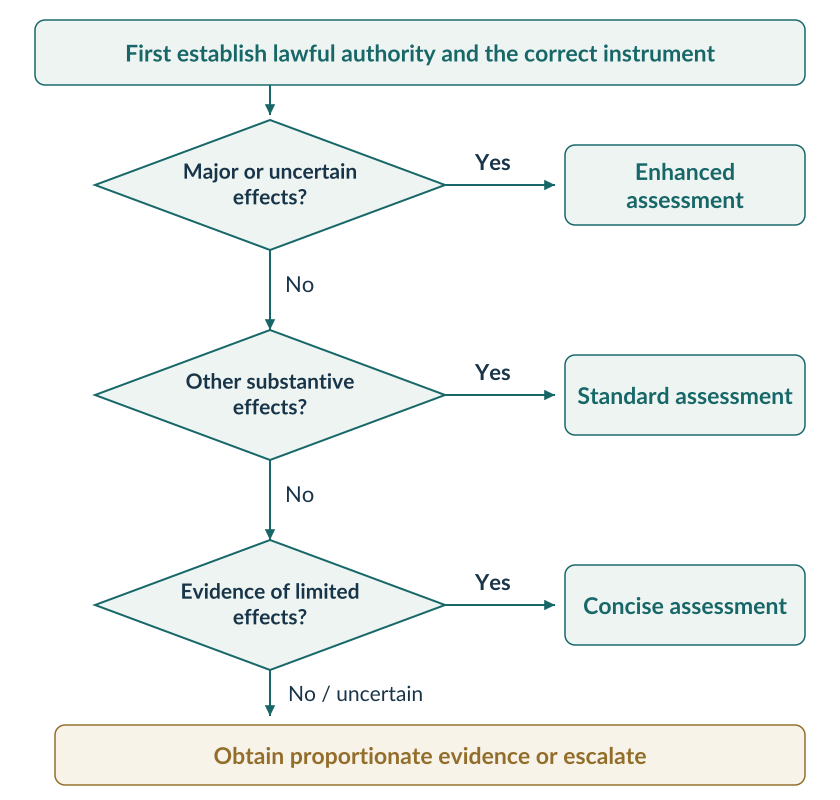
First establish lawful authority. Substantial, uncertain, irreversible or materially unequal effects call for enhanced assessment. Other substantive changes call for standard assessment. A concise assessment needs evidence of limited effects. Uncertainty warrants more evidence or escalation; no tier displaces applicable legal safeguards.
3. Problem definition, baseline and regulatory objectives
No proposal should advance on a general assertion that it will improve efficiency. The initiating team should identify the specific failure, its magnitude, its causes and the limits of the available evidence.
The baseline should describe both present conditions and what is reasonably expected to happen without the proposed change. Include already notified changes whose effects are still emerging. Distinguish deficient regulatory design from non-compliance with existing rules, weak enforcement, missing information, infrastructure constraints and judicial delay.
Define intended outcomes before selecting the preferred intervention. For example, a reporting reform might seek to reduce duplicate submissions while maintaining reliable supervision. Increased filing volume is an activity measure; improved completeness, earlier detection of material problems and reduced avoidable effort are possible outcomes. Each outcome should have an owner, a measure or qualitative test, a baseline and a review horizon.
4. Alternatives and the explanation for choosing one
Compare the proposed measure against the no-change baseline and credible alternatives that can lawfully achieve the objective.
Depending on the problem, alternatives could include better enforcement of existing requirements, clearer guidance, better data exchange, simpler forms, different reporting frequencies, risk-based requirements, phased commencement or narrower application. Explain why an apparently relevant alternative was rejected. Avoid weak alternatives included merely to make the preferred option look attractive.
For each option, record expected effects, implementation feasibility, affected groups, uncertainty and remaining risks. Use cost-benefit analysis when defensible, cost-effectiveness analysis where a common outcome is measurable, and a transparent qualitative or multi-criteria comparison when monetary valuation would be artificial. Explain weights and test whether reasonable changes to them reverse the choice. No aggregate score should conceal a decisive legal or fairness concern.
5. Twelve insolvency-specific impact dimensions
Use the following dimensions as an assessment checklist. Examine all for relevance; investigate material effects in depth and give reasons for exclusions. They are not a universal weighted index or a direction to optimise one recovery statistic. Several dimensions may describe the same underlying effect. Record each effect once in an aggregate calculation: preserved enterprise value and higher creditor receipts may, for example, reflect the same gain.
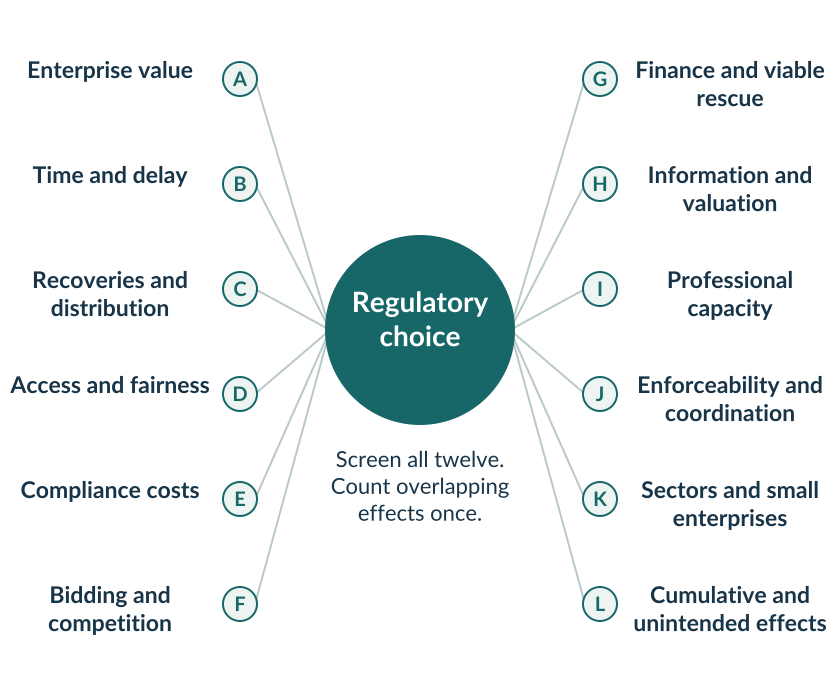
Assess enterprise value, time, distribution, access, costs, competition, rescue finance, information, professional capacity, enforceability, sectoral effects and cumulative burden. The A–L labels match the detailed article subsections. All twelve are screened for relevance; neither their position nor their size denotes weight or priority.
Open full-size diagram · Download PDF · Assessment questions and evidence
A. Preservation and realisation of enterprise value
Question: Does the measure help preserve viable operations, reduce avoidable deterioration or improve realisation of assets, and at what cost?
Evidence and measures: business continuity; asset-maintenance expenditure; operational disruption; sale or resolution receipts; realisation relative to clearly defined valuation benchmarks. Separate comparable case types and valuation dates. Higher realisation relative to a potentially stale valuation is not, by itself, evidence that the regulation created value.
B. Duration, predictability and the cost of delay
Question: Which process step changes, who controls it, and does faster completion preserve necessary safeguards?
Evidence and measures: stage-specific median and upper-percentile duration; time to actual distribution; rework and adjournment reasons where reliable; variation across case cohorts. Show pending cases and their age so that only quick completed cases do not determine the apparent result. Separate professional, creditor, market and adjudicatory contributions rather than attributing the entire interval to IBBI.
C. Recoveries and distribution among stakeholders
Question: Who receives more or less, when do they receive it, and does the proposal alter burdens across groups?
Evidence and measures: actual receipts separately from promised plan payments; receipts against admitted claims with consistent denominators; distributions by creditor class; costs deducted before distribution; time to receipt. Examine secured and unsecured financial creditors, operational creditors, employees, homebuyers and other relevant groups separately. Transfers between groups are distributional effects, not automatically additions to total social value.
D. Access, participation and procedural fairness
Question: Can affected parties receive usable information, submit claims, participate and obtain available remedies without unreasonable barriers?
Evidence and measures: claim-deficiency and correction rates; participation and communication failures; accessibility of notices and systems; cost of asserting small claims; reasons for exclusion or rejection. Disaggregate where lawful and feasible. Fewer objections or complaints may reflect better processes or suppressed access; interpretation needs additional evidence.
E. Compliance, professional and administrative costs
Question: What additional or avoided resources will stakeholders and the regulator use, including transition costs?
Evidence and measures: task-level staff hours; technology changes; external assistance; training; filing and verification effort; recurring versus one-time costs; effects by estate size and professional practice size. Use a validated range for task frequency and reasonable labour-cost assumptions. Avoid counting a service fee and the same provider's resource inputs twice in the social-cost total. Show cash-flow incidence separately from resource cost.
F. Bidding, market participation and competition
Question: Does the measure encourage credible participation while protecting integrity, or create avoidable entry barriers and concentration?
Evidence and measures: expressions of interest, qualified bidders and effective bids as distinct stages; failed auctions; bidder withdrawal reasons; participation costs; market concentration where the sample permits. More bids do not necessarily mean better bids. Evaluate eligibility safeguards and potential collusion risks alongside participation.
G. Interim finance and prospects of viable rescue
Question: Does the intervention improve access to necessary funding and viable restructuring without encouraging value-destructive continuation?
Evidence and measures: availability, price and actual use of interim finance; continuity of essential operations; funding shortfalls; feasibility and implementation of approved plans. Separate financing transfers from transaction costs and real effects on enterprise value. Do not prescribe rescue at any cost or treat liquidation as inherently a policy failure.
H. Information quality, valuation and market confidence
Question: Does the measure improve the reliability, timeliness and usability of information without requiring unnecessary collection?
Evidence and measures: missing or inconsistent fields; correction rates; data duplication; valuation-report completeness; material disclosure failures; time spent reconciling records. Examine valuation uncertainty and differing assumptions before treating dispersion as error. Consider confidentiality, legitimate access, data minimisation and security.
I. Professional capacity, incentives and accountability
Question: Can professionals and service providers meet the requirement, and what behaviours will it encourage?
Evidence and measures: workload and available skills; training needs; geographical access; conflicts of interest; remuneration incentives; quality findings; supervision effort. Consider insolvency professionals, their agencies, valuers, information utilities and other relevant providers according to the proposal. Changes in registrations or disciplinary cases require contextual interpretation, not automatic classification as success or failure.
J. Litigation, enforceability and institutional coordination
Question: Is the measure clear, implementable and consistent with superior law, and does it create conflicting duties or procedural disputes?
Evidence and measures: ambiguities identified in legal review; types and reasons for challenges; contradictory reporting requirements; implementation dependencies involving the Ministry of Corporate Affairs, courts, tribunals and other regulators. Litigation reduction is not an overriding objective where a remedy protects legitimate rights. Do not present judicial outcomes as administrative targets for IBBI.
K. Sectoral effects and smaller enterprises
Question: Does a uniform requirement have disproportionate effects in particular sectors, smaller estates or lower-capacity settings?
Evidence and measures: effects by case size, sector, process and relevant business characteristics; fixed compliance costs relative to estate resources; practical consequences for real estate, asset-light businesses and other affected groups. Include employment, livelihood, consumer, local-community or environmental effects where material to the proposal and within the assessment's legitimate scope. Avoid assuming a one-size-fits-all response is proportionate.
L. Cumulative burden, transition and unintended effects
Question: How does the measure interact with other changes, existing cases and incentives to avoid or game requirements?
Evidence and measures: total reporting load; overlap with existing information; implementation lead time; migration effort; treatment of ongoing cases; gaming and displacement risks; dependency on unready systems. Assess cohorts under different legal versions separately. Any pilot, transition protection or differentiated treatment needs a lawful basis and an express fairness assessment.
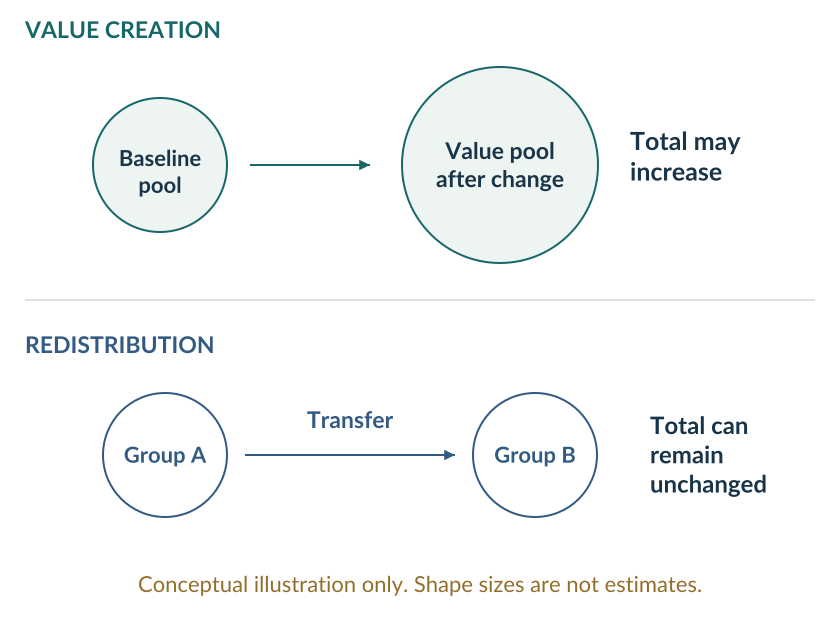
The upper schematic shows the conceptual possibility of increasing total value. The lower shows value moving between groups without increasing the total. Shapes are illustrative, not data. Actual assessment must identify recipients, timing and resource costs, and avoid counting the same gain both as enterprise value and as creditor receipts.
6. Evidence standards and an insolvency data plan
Every material assessment should include a data and assumptions register sufficient for another reviewer to understand and, where possible, reproduce its reasoning.
Record the source, collection period, population, sample, variable definitions, missingness and limitations. Define each indicator's numerator, denominator, unit, observation window, case status and legal version. Preserve an account of revisions. Distinguish administrative records, stakeholder estimates, survey perceptions and analyst assumptions. State the appraisal period, price basis, treatment of future payments and any discount assumptions. Explain their suitability for the proposal and test material uncertainty. Show aggregate results alongside case-level distributions so that a few large cases do not conceal other experience. Separate corporate resolution, liquidation and personal processes. Explain non-cash consideration and claim revisions; show zero-realisation cases separately when presenting cost-to-realisation ratios.
Group cases by admission period, process, sector, estate size and other relevant pre-existing characteristics. Include unsuccessful and pending cases where relevant. Describe selection bias, incomplete payments, time lags and changes in case mix. Use uncertainty ranges and sensitivity analysis; do not manufacture estimates to fill gaps.
Before requesting additional returns, identify whether existing IBBI records, filings or lawfully accessible public information can answer the question. New collection should be necessary, proportionate and feasible. Where data sharing is needed, identify its authority, purpose, access controls, retention, confidentiality protections and responsibilities. Publish reproducible aggregate methods without exposing case-level confidential or personal data.
An evidence gap should result in a reasoned choice: obtain more information, narrow or phase the proposal where lawful, use clearly qualified qualitative analysis, or defer a non-urgent decision. It should not automatically count as zero cost or justify an unlimited exemption from assessment.
7. Consultation, inclusion and public reasons
Publish the draft assessment with the proposed measure and ask focused questions about assumptions, alternatives, costs, benefits and implementation.
Seek evidence from affected stakeholders beyond the most organised participants. Use appropriate outreach to smaller creditors, employees, homebuyers and smaller professional practices, while avoiding duplication and unnecessary consultation burdens. Explain confidential submission arrangements and publish a non-confidential account of the evidence received.
The response statement should identify material points, changes made, reasons for retaining disputed assumptions and remaining uncertainty. Consultation is not a vote by the best represented group. Apply the existing legal consultation and re-consultation requirements; a concise RIA tier should not become a device for shortening them.
8. Preparation, independent challenge and decision accountability
Allocate clear responsibility for preparation, methodological review, legal review, approval and later evaluation.
- The sponsoring division should own the problem statement and intervention design.
- A designated analytical function should support data, methods and proportionality, with resources and training commensurate with workload. Its organisational form should follow a capacity assessment; a new standalone body is not assumed necessary.
- Legal reviewers should identify authority, statutory limits, procedural requirements and the correct instrument.
- For material proposals, reviewers independent of the drafting team should challenge alternatives, assumptions and conclusions. External expertise may supplement internal capacity, subject to conflicts, confidentiality and independence safeguards.
- The competent decision-maker should retain legal responsibility. Reviewers should not obtain an unlegislated veto. Material departures from analytical advice should be explained on the record.
- A named evaluation owner should be designated before commencement, preferably with sufficient separation from the original assessment to support credible review.
Publish the assessment, non-confidential review findings and reasoned response in a connected record. Requirements not achievable through current administrative powers should be recommended through the appropriate formal amendment route.
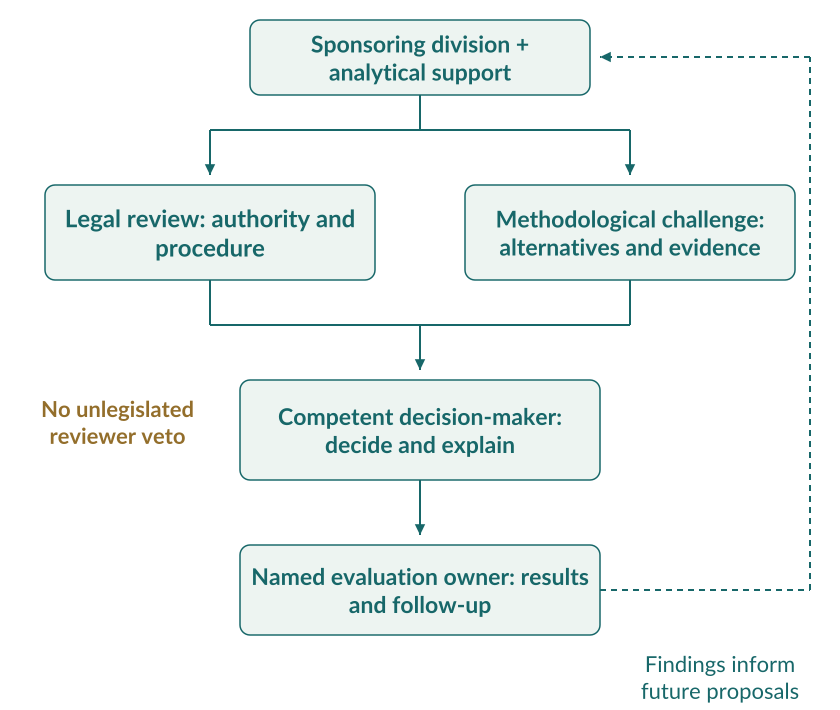
The sponsor prepares with analytical support. Legal review examines authority and procedure; methodological challenge examines alternatives and evidence, independently of the drafting team for material proposals. Findings inform the competent decision-maker, who retains legal responsibility. A named owner evaluates implementation and outcomes and feeds findings back.
9. Decision record and urgent measures
The final decision record should state the preferred option, rejected alternatives, expected effects, important distributional consequences, uncertainty, implementation arrangements and planned review.
Available conclusions should include proceeding, modifying, deferring, seeking additional evidence or taking no new regulatory action. Positive estimated net benefits should not be the sole decision rule. Legal constraints, rights, distribution, uncertainty and feasibility require express treatment. Where costs and benefits cannot be credibly monetised, explain the reasoning without false precision.
For urgent action permitted under the applicable framework, propose recording the urgency, the authority used, minimum available evidence and the consequences of delay. A proportionate subsequent assessment and a stated reconsideration date should be recommended, with their precise obligations and deadlines established through the appropriate route. The proposed follow-up duty would need an appropriate legal or administrative basis. A scheduled review would not itself cause the regulation to expire. Distinguish a scheduled review from automatic expiry, which could disrupt ongoing cases.
10. Evaluation after implementation
Set the evaluation questions, baseline, data sources, responsible team and review horizon when the measure is adopted, and connect the results with IBBI's existing periodic review arrangements.
Separate three questions: whether the measure was implemented as intended; whether expected outcomes emerged; and how far any observed change can credibly be attributed to the measure. A before-and-after comparison alone may be misleading because of macroeconomic conditions, judicial capacity, case composition or concurrent reforms.
Select an evaluation method proportionate to the question and available evidence. Comparison cohorts or more demanding causal methods require credible assumptions and sufficient data; otherwise present a qualified descriptive or contribution-based evaluation. Do not delay all learning until long cases conclude: use early implementation measures while reserving recovery and durable rescue judgments for suitably mature cohorts.
Specify in advance the evidence that would trigger reconsideration, such as sustained disproportionate burdens, impaired participation, recurring implementation failures or failure to achieve the stated objective. Targets should be calibrated, not invented. The review should recommend retention, modification, consolidation or withdrawal where justified, with a responsible authority and published follow-up. Preserve transition protections and legal certainty for existing cases.
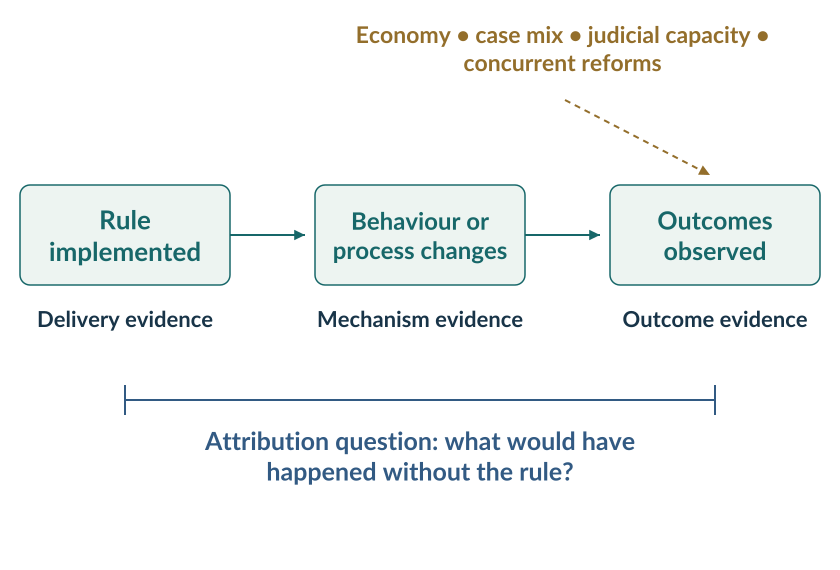
Separate whether implementation occurred, whether outcomes changed and how much the rule contributed. The pathway shows the intended mechanism; economic conditions, case mix, court capacity and other reforms can also affect outcomes. Credible attribution needs a counterfactual and defensible assumptions, otherwise findings should remain qualified.
11. A standard assessment statement
Adopt one common assessment statement with depth scaled to significance. Its fields should be:
- Proposal identifier, version, sponsor, competent authority and intended decision date.
- Enabling provision, legal constraints and the selected regulatory instrument.
- Screening category, reasons and reviewer.
- Problem, causes, affected population and supporting evidence.
- Baseline, no-change trajectory and measurable objectives.
- Credible alternatives and reasons for exclusion.
- Relevant insolvency impact dimensions and distribution among groups.
- Cost, benefit and uncertainty analysis, including data limitations.
- Consultation evidence, responses and changes to the proposal.
- Legal and methodological review findings and responses.
- Preferred option, reasons, residual risks and decision sign-off.
- Transition, training, technology and enforcement arrangements.
- Indicators, data responsibilities, evaluation method and review schedule.
- Publication record, confidentiality treatment and version history.
Attach only the additional schedules warranted by the proposal: an options comparison, stakeholder impact statement, cost worksheet, data register, implementation plan and evaluation plan. Do not make every minor change carry an unnecessarily large dossier.
12. Testing the framework against a reporting reform
Reporting is a useful test because IBBI has already recognised its burdens. Board Note 76/2020 compared existing arrangements with additional process reporting and identified IT-module costs for the regulator and marginal professional compliance costs. Its anticipated monitoring benefits were forecasts, not a measurement of achieved results. The next analytical step would be to expose the assumptions and test the effects after implementation. [10]
Consider a hypothetical revision of insolvency reporting. Four options merit examination: current reporting, more frequent reporting, simplification of existing forms and risk-based reporting. The starting point is the supervisory decision that the information must support. If the same information already exists in accessible records, an additional return may create work without improving the decision. Conversely, removing a field without understanding its use could weaken oversight.
Estimate recurring effort separately for each affected group: number of cases multiplied by submissions per case, time per submission and the relevant staff-resource cost per unit of time. Add verification, correction and supervisory effort where not already included. Compare that total with the same calculation for the baseline; add one-time system and training costs separately, with a stated appraisal period. The estimated difference would depend on validated case counts, task times and resource costs; this illustration establishes the calculation without claiming savings from an actual measure. Assess data reliability, timeliness and supervisory usefulness alongside cost. Test small-estate effects and situations where reduced reporting could hide material risks. State the evidence needed to prefer an option. Any claimed savings or outcome gains would require supporting data.
A hypothetical eligibility requirement exposes a different trade-off. Stricter qualification might improve bidder reliability while excluding otherwise credible participants and increasing compliance effort. The assessment should examine both effects, identify whose participation would change, and test narrower ways of addressing the underlying risk. The preferred option cannot be inferred from bidder numbers alone. These illustrations specify the reasoning and evidence needed; they do not purport to estimate the effects of an actual IBBI measure.
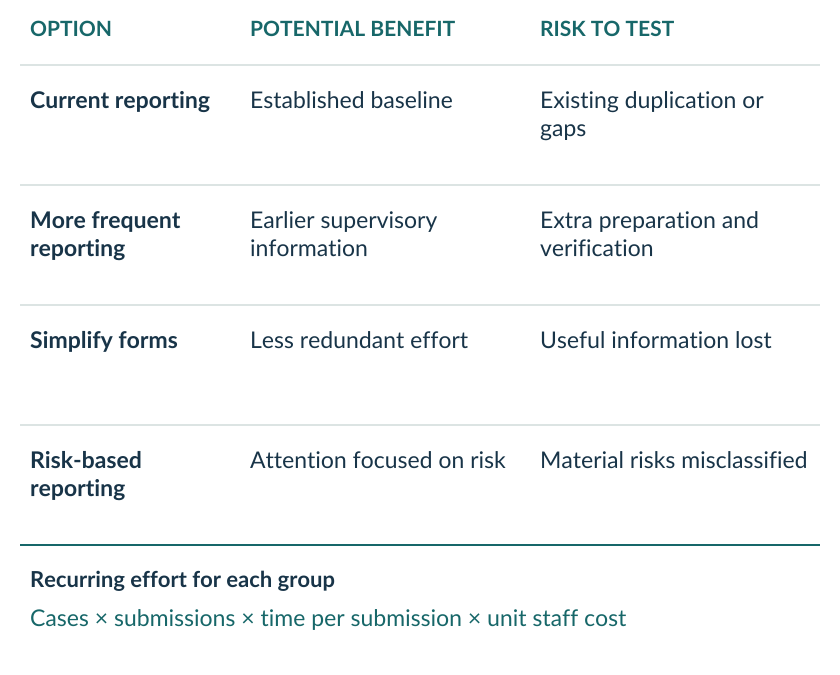
Compare current reporting, more frequent reporting, simplified forms and risk-based reporting. Test information usefulness and burden for every option, including small-estate effects. These are hypotheses, not measured results or a ranking. Estimate recurring staff effort from cases, submission frequency, task time and unit resource cost, with one-time costs separately.
13. Phased adoption and monitoring of the framework itself
Introduce the methodology through a bounded pilot, evaluate its usefulness and burden, and expand it in stages.
Indicative periods measured from institutional adoption, not commitments or existing statutory deadlines:
- First three months: map existing arrangements, determine legal routes, designate owners, assess capacity, agree a data dictionary and consult on the methodology.
- Months four to six: pilot across contrasting proposals, such as reporting, professional requirements and a material process change; establish a pilot assessment register and independently examine completed assessments and stakeholder experience.
- Months seven to twelve: revise templates and screening criteria, train teams, expand the assessment register and apply the methodology progressively within lawful authority.
- After the first year: review the methodology's own cost, analytical quality and influence on decisions. Evaluate individual regulations when their outcome data are mature and in accordance with applicable review obligations.
Monitor whether assessments start early enough to affect options; whether evidence changes proposals; whether reviews address substantive weaknesses; whether stakeholders receive reasoned responses; and whether evaluation findings lead to action. Counting completed documents alone is not evidence of better regulation. Publish implementation progress, unresolved dependencies and reasons for material departures.
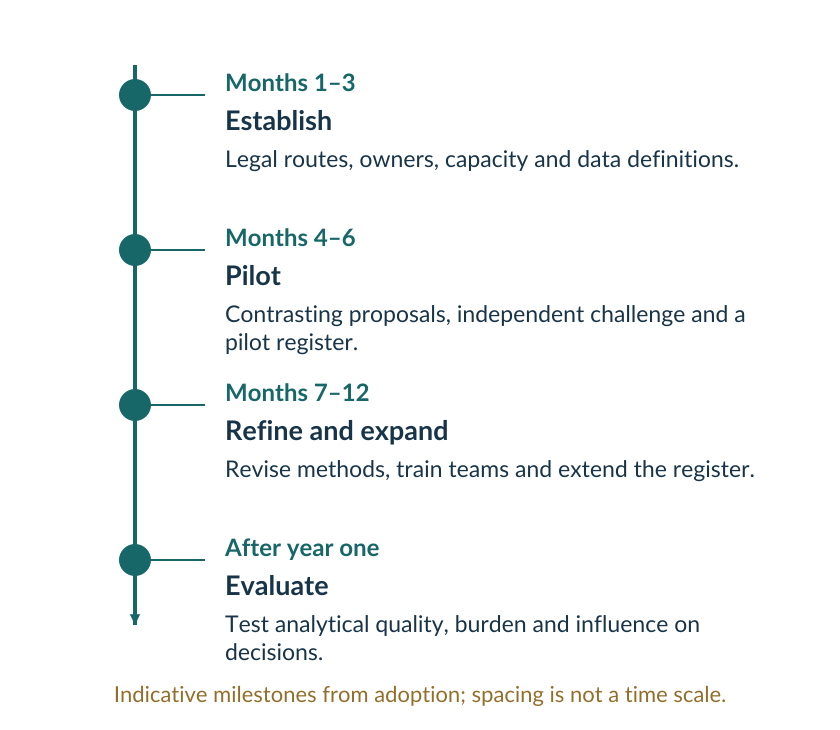
Indicative milestones run from formal adoption: establish authority and capacity in months 1–3; pilot contrasting proposals and a pilot register in months 4–6; refine and expand in months 7–12; evaluate the methodology after year one. These are proposed milestones, not statutory deadlines. Spacing is schematic and does not encode duration.
14. Recommendations for institutional adoption
A committee can translate the framework into ten recommendations with assigned responsibility and a test of completion. The clauses below are model recommendations for adaptation, not findings of an existing committee. Each recommendation must be reconciled with the committee’s mandate and the powers of the implementing authority. The indicative periods run from adoption; they are proposed implementation targets, not existing statutory deadlines.
Recommendation 1 — Adopt the methodology
IBBI should adopt and publish an insolvency-specific regulatory impact assessment and review methodology, building on its existing regulation-making framework.
Owner and route: Governing Board with legal and policy support; administrative governance measures within existing authority, formal amendment where necessary. Deliverable and timing: a mapped legal basis and draft methodology within three months. Quality test: each proposed requirement has an identified authority, responsible function and implementation path.
Recommendation 2 — Preserve proportionality and legal safeguards
The methodology should require recorded screening of covered proposals, with analytical depth proportionate to materiality, distributional consequences and uncertainty, without creating exemptions from applicable legal procedures.
Owner and route: sponsoring division, analytical function and legal reviewer. Deliverable and timing: screening form and escalation criteria for the initial pilot. Quality test: reasons are auditable; related measures are assessed cumulatively; rights and small-stakeholder effects can trigger deeper review regardless of monetary cost.
Recommendation 3 — Require real choices and an impact statement
Each assessment should identify the problem and baseline, consider credible lawful alternatives, and explain expected effects using an insolvency-specific impact statement.
Owner and route: sponsoring division supported by analysts; Board-approved methodology within lawful authority. Deliverable and timing: completed statements for each pilot proposal during months four to six. Quality test: alternatives could realistically affect the choice; costs, benefits, affected groups and material uncertainties are addressed, with justified exclusions from the twelve dimensions.
Recommendation 4 — Establish a proportionate evidence system
IBBI should maintain common indicator definitions and an evidence register, reuse lawfully available information and justify new data collection by its decision value and burden.
Owner and route: designated data custodian with policy and legal functions; lawful data-sharing arrangements where needed. Deliverable and timing: pilot data dictionary, access protocol and assumptions register by the start of pilot assessments. Quality test: a reviewer can trace each material estimate; confidential data are protected; missing observations and denominators are disclosed.
Recommendation 5 — Provide challenge independent of authors
Material assessments should receive methodological review independent of their authors, with appropriate external expertise for major or contested proposals, while the competent authority retains decision-making responsibility.
Owner and route: Board-approved reviewer arrangements, subject to existing powers and resources. Deliverable and timing: reviewer terms, conflict rules and response process before pilot decisions. Quality test: substantive objections and responses accompany the decision; the competent authority retains the final decision, with reasons for departures from material analytical advice.
Recommendation 6 — Connect consultation to the assessment
Consultation should expose the proposed measure's assumptions and alternatives to affected groups, and the final record should explain how material evidence and objections affected the decision.
Owner and route: sponsoring division with communications, legal and analytical support; existing consultation duties remain applicable. Deliverable and timing: draft assessment, focused questions and response statement at the legally appropriate stages of each proposal. Quality test: participation barriers and conflicting interests receive reasoned consideration; confidentiality and publication are lawfully reconciled.
Recommendation 7 — Establish an urgent-measure follow-up process
Where urgent regulation is lawfully justified, reasons, available impact evidence and a proportionate subsequent assessment and reconsideration plan should be recorded and published to the extent legally permissible.
Owner and route: Governing Board and sponsoring division; formal changes if binding new duties are proposed. Deliverable and timing: emergency protocol included in the methodology, with measure-specific follow-up dates set at adoption. Quality test: urgency does not become an indefinite exemption from scrutiny; no unsupported automatic expiry disrupts ongoing cases.
Recommendation 8 — Plan delivery and evaluation together
Material measures should carry an implementation and evaluation plan identifying responsible institutions, transition arrangements, indicators, data sources, review dates and reconsideration triggers.
Owner and route: sponsoring division, relevant implementation bodies and designated evaluation team, each within its powers. Deliverable and timing: plan before commencement, early implementation checks when useful, and outcome review when cohorts are sufficiently mature and within applicable review requirements. Quality test: implementation, outcomes and causal attribution are distinguished; adverse findings lead to a reasoned action decision.
Recommendation 9 — Publish a connected decision and review record
IBBI should maintain a public register connecting screening, assessments, consultation responses, material reviewer findings, final reasons, implementation progress and subsequent reviews through a common proposal identifier.
Owner and route: designated registry function with lawful disclosure controls. Deliverable and timing: register established during the pilot and expanded within twelve months. Quality test: a reader can follow the decision and its later evaluation; lawful redactions and material delays are explained.
Recommendation 10 — Pilot, resource and evaluate the methodology
Adoption should proceed through a disclosed pilot across contrasting interventions, supported by staff training and a capacity assessment, followed by independent review and progressive expansion.
Owner and route: Governing Board, analytical and sponsoring divisions; staffing and budget approvals through competent channels. Deliverable and timing: pilot during months four to six; findings, revised methodology and expansion plan within twelve months. Quality test: review examines whether analysis improved choices and exposed unintended effects, as well as its cost and burden; completion counts alone are insufficient.
Conclusion
IBBI has an established foundation for economic analysis, consultation and regulatory review. The opportunity is to make those disciplines more consistently useful: a clear explanation of the problem, credible alternatives, a proportionate account of benefits and burdens, and a plan for learning from implementation.
Insolvency requires particular care. Value can deteriorate while information is assembled; safeguards can protect one group while imposing costs on another; a faster procedure can still produce an unfair or poorly informed decision. An assessment framework must make those tensions visible. It cannot substitute a single recovery percentage, a monetary score or a foreign template for judgement within the law.
A workable framework would give policy teams methods and evidence, give affected stakeholders meaningful opportunities to challenge assumptions, and give the Governing Board a reasoned basis for its choices. Its eventual success would lie in decisions that change when the evidence demands it—and in a public record that explains why.
References
- OECD. Regulatory Impact Assessment: Best Practice Principles for Regulatory Policy. 2020. Chapter 2, Best practice principles for regulatory impact analysis. ↩
- Insolvency and Bankruptcy Board of India. Insolvency and Bankruptcy Board of India (Mechanism for Issuing Regulations) Regulations, 2018. 2018-10-22. p. 1, reg. 1(3); p. 2, regs. 3–5; p. 3, regs. 6–8. ↩
- Insolvency and Bankruptcy Board of India. Corporate Insolvency Resolution Process: Improving timelines and enhancing dissemination of information. Board Note 58/2020. 2020. p. 4, para. 2.5; Annexure I, pp. 15–16. ↩
- Insolvency and Bankruptcy Board of India. Amendments to the IBBI (Liquidation Process) Regulations, 2016. Board Note 80/2020. 2020. pp. 2–3, paras. 4–5; Annexure B, pp. 5–6. ↩
- Insolvency and Bankruptcy Board of India. The Stakeholder Consultation Process and Review of Regulations. July–September 2025. printed p. 2 / PDF p. 4. ↩
- OECD. Applying regulatory impact assessment at regulatory authorities: A methodology for assessing the economic, social and environmental impacts of regulation. 2025-10-15. pp. 8, 12–13, 19 and 42. ↩
- Financial Conduct Authority. Statement of Policy on Cost Benefit Analyses. 2024-07. paras. 3.6, 3.15–3.21 and Appendix 7; linked from current FCA gateway on 21 November 2026. ↩
- Financial Conduct Authority. Evaluating our work. 2025-07-10. Impact evaluation, evidence assessment and post-implementation review. ↩
- Australian Government, Office of Impact Analysis. Impact Analysis Framework: Practical Guide for Agencies. 2026-06. p. 13, Statement of Sufficiency; framework commenced 1 July 2026. ↩
- Insolvency and Bankruptcy Board of India. Amendments to the IBBI (Insolvency Resolution Process for Corporate Persons) Regulations, 2016. Board Note 76/2020. 2020. pp. 2–3, paras. 1.3–1.5 and Table 3; Annexure I, item 1, pp. 7–8. ↩
Disclaimer: This article is published for academic and educational purposes only. It does not constitute legal advice or a legal opinion. It was prepared with AI assistance and reviewed before publication. Readers should consult the relevant laws, regulations, and cited source materials before relying on any proposition discussed here.
Subscribe for new article alerts
Receive an email when a new Insolvation article is published. No unrelated marketing.
Collected here: your email address and consent proof for article-alert delivery. Purpose: confirmation and new-article alerts. Retention: active while subscribed, with suppression records retained after unsubscribe to honor your opt-out. Details: Privacy notice · Privacy rights.