Building an Entrepreneur Debt Assistance Architecture in India: A Practical Framework for Insolvent and Bankrupt Founders
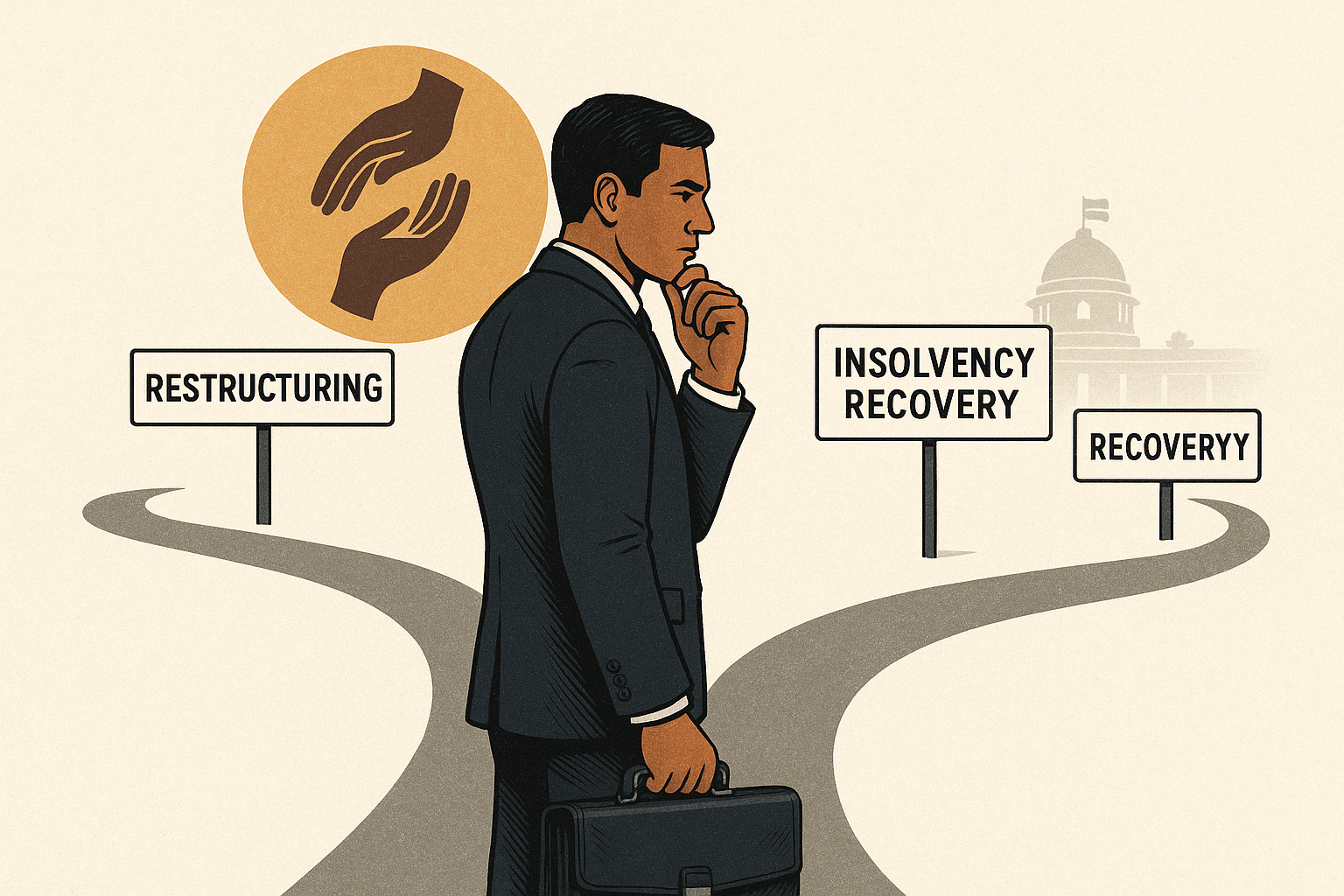
India has formal insolvency law, lender-led stress resolution tools, and a delayed-payment platform for MSMEs. What it still lacks is a practical founder-facing route that helps distressed entrepreneurs understand their position early, preserve business value where possible, and move to closure or restructuring before matters harden into litigation or insolvency. That gap is visible because the current architecture is distributed across lender processes, insolvency procedures, and MSME receivable-recovery channels rather than presented as one navigable support pathway for a founder in trouble. the earlier RBI stressed-assets framework (withdrawn)[2][3]
For many entrepreneurs, distress does not begin with a single legal event. It begins with delayed receivables, short-term borrowing used for operating survival, repeated repayment pressure, or the creeping realization that the business no longer has room for one more missed payment cycle. A useful assistance architecture therefore has to start before formal insolvency. Its purpose is not to replace lenders, tribunals, or insolvency professionals. Its purpose is to help the entrepreneur reach the right channel earlier, with clearer records and better judgment. the earlier RBI stressed-assets framework (withdrawn)[2]
Why the gap matters in practice
The Reserve Bank of India's prudential framework is aimed at early recognition and resolution of stress in lending relationships. The IBBI framework, by contrast, sits at the formal insolvency and restructuring end of the spectrum. MSME Samadhaan addresses a different but important problem: delayed payments to MSMEs. Each of these tools serves a valid purpose, but none of them by itself functions as a plain-language, founder-oriented debt navigation system. A founder under pressure may therefore face a fragmented reality: one set of conversations with lenders, another with legal advisers, and a separate effort to recover overdue receivables. the earlier RBI stressed-assets framework (withdrawn)[2][3]
That fragmentation increases value destruction. Entrepreneurs often wait too long, partly because they do not know which problem they are actually facing. A temporary liquidity squeeze, an over-leveraged but viable business, and a structurally failed enterprise do not call for the same response. Yet these situations are commonly handled in the same atmosphere of urgency and confusion. A disciplined assistance architecture should prevent that collapse of categories by forcing early triage.
What an early-stage founder support architecture should do
A practical Indian model should begin with a structured intake. The first task is to map the position of the business: outstanding debt, secured and unsecured exposure, personal guarantee risk, overdue receivables, statutory arrears, ongoing litigation, and the immediate cash runway. Once that picture is clear, the founder can be routed to the most relevant next step: lender engagement, receivable recovery, operational restructuring, insolvency advice, or an orderly closure discussion. This is a navigation problem before it becomes a litigation problem.
Such a system should also improve document readiness. Distress becomes harder to manage when the entrepreneur cannot quickly produce loan documents, account statements, receivable schedules, security details, demand notices, and board or partner approvals. Even where the final route lies outside insolvency, better records improve negotiation quality and reduce the risk of avoidable escalation.
The core design principle: triage before insolvency
The most important discipline is early classification. The article does not suggest that every distressed founder should move toward insolvency. It suggests the opposite: that the system should distinguish between cases that need time and coordination, cases that need formal restructuring advice, and cases where the honest answer is that closure should be planned rather than postponed.
Table 1. Distress triage for founder-facing debt assistance.
| Distress type | What it usually looks like | Preferred routing response |
|---|---|---|
| Temporary liquidity stress | Orders or customers still exist, but the business has near-term cash compression and repayment pressure. | Immediate cash-flow review, lender engagement, receivable recovery, and tighter operating controls. |
| Viable core business with unsustainable debt structure | The enterprise can trade, but existing debt terms or accumulated liabilities have become unrealistic. | Structured restructuring advice, lender coordination, and early legal review of available formal options. |
| Receivable-led stress in an MSME context | A business becomes distressed because buyers are not paying on time and working capital has been absorbed by overdue invoices. | Document overdue claims early and use the MSME delayed-payment channel where applicable. [3] |
| Non-viable enterprise | The business model is no longer commercially recoverable, even with more time. | Orderly closure planning, professional advice on liabilities and guarantees, and preservation of records for the next formal step. [2] |
How the architecture should connect to the current Indian system
The architecture should not duplicate institutions that already exist. It should connect entrepreneurs to them more intelligently. Where lender stress is central, the founder should understand that the banking relationship may move under a prudential stress-resolution framework and that delay usually reduces flexibility. Where the real problem is unpaid MSME receivables, the response should begin with documented recovery and escalation through the delayed-payment mechanism. Where the enterprise may require a formal insolvency or restructuring route, the founder should be directed toward current IBBI-governed pathways and competent professional advice. the earlier RBI stressed-assets framework (withdrawn)[2][3]
Table 2. Practical routing inside the current Indian framework.
| Immediate founder problem | Most relevant institutional route | Why that route matters |
|---|---|---|
| Lender stress, slippage, or repeated restructuring pressure | RBI-regulated lender resolution and restructuring processes the earlier RBI stressed-assets framework (withdrawn) | It is the main early formal route before the situation hardens into more serious proceedings. |
| Overdue MSME invoices impairing cash flow | MSME Samadhaan delayed-payment mechanism [3] | It addresses one of the most common triggers of founder distress: receivables that are not arriving in time. |
| Need for formal insolvency or restructuring analysis | Current IBBI legal and regulatory framework [2] | It is the appropriate reference point for current insolvency procedures, service-provider regulation, and updated legal materials. |
What India should build next
India would benefit from a plain-language entrepreneur distress layer that sits before formal breakdown. At minimum, that layer should offer intake triage, document checklists, receivable-risk review for MSMEs, lender-engagement guidance, and clear routing to current insolvency or restructuring channels where needed. It should also help founders understand that not every failing business should be kept alive. A good system is not a rescue promise. It is an early decision architecture.
That design would be especially useful for smaller businesses, where founders often combine operational, financial, and personal guarantee risk in the same individual. Earlier classification, better records, and faster routing will not eliminate business failure. They will, however, reduce avoidable value destruction and improve the quality of decisions taken before formal collapse.
Conclusion
India does not need another abstract conversation about entrepreneurship and failure. It needs a practical founder-side architecture that makes existing tools easier to reach, easier to understand, and easier to use at the right time. The essential principle is simple: triage early, document properly, route intelligently, and move to formal insolvency only when the facts justify it. the earlier RBI stressed-assets framework (withdrawn)[2][3]
Finally, a credible architecture must be honest about closure. Founder assistance loses credibility if it pretends every business can be rescued with more time, another bridge facility, or softer negotiation language. Some cases need preservation, some need restructuring, and some need orderly wind-down planning before further erosion of value or personal exposure. The policy strength of a founder-facing system comes from making those distinctions earlier and more clearly. That is why triage tables, creditor-routing guidance, receivable-recovery tracks, and advisory escalation points matter: they help replace improvisation with decision structure. In practice, the best assistance architecture is one that helps viable founders stabilise quickly, helps overleveraged but salvageable founders reach formal advice before options collapse, and helps unsalvageable cases move toward orderly closure without further avoidable damage. [1][2]
That architecture also needs an operational bridge between advisory help and formal legal pathways. Many founders do not fail because there is no law available; they fail because the gap between ordinary business stress and formal restructuring advice is too wide, too technical, or too late. A serious support model should therefore combine early cash-flow review, receivable recovery strategy, lender communication discipline, guarantee mapping, and timely referral to regulated professionals where formal options must be assessed. In the MSME setting, this bridge is especially important because payment delay, contractual imbalance, and fragmented borrowing can create distress long before a founder is ready to think in insolvency vocabulary. Mechanisms such as delayed-payment redress and structured creditor engagement are therefore relevant not as standalone cures, but as routing tools inside a broader founder-support architecture. [1][3]
A real entrepreneur debt-assistance architecture cannot stop at giving distressed founders general information about insolvency. It has to route them into the right problem-solving lane early enough that delay does not destroy the remaining options. In India, that means distinguishing between legal distress, liquidity distress, receivable-led distress, and viability distress rather than treating all founder hardship as a single insolvency category. A founder who still has a functioning business but is trapped by working-capital compression needs a different intervention from a founder facing accumulated statutory defaults, personal guarantees, and collapsing creditor trust. The public-value case for an assistance architecture therefore lies in intelligent triage, not just compassionate messaging. If the routing is wrong, the founder loses time, creditors lose confidence, and eventual formal processes become harder and more expensive. [1]
What a real founder-facing assistance architecture should contain
References
Disclaimer: This article is published for academic and educational purposes only. It does not constitute legal advice or a legal opinion. It was prepared with AI assistance and reviewed before publication. Readers should consult the relevant laws, regulations, and cited source materials before relying on any proposition discussed here.
Subscribe for new article alerts
Receive an email when a new Insolvation article is published. No unrelated marketing.
Collected here: your email address and consent proof for article-alert delivery. Purpose: confirmation and new-article alerts. Retention: active while subscribed, with suppression records retained after unsubscribe to honor your opt-out. Details: Privacy notice · Privacy rights.